.png?width=268&height=52&name=f1-logo2%20(1).png)

In hospitals, every second counts. When a piece of equipment fails or a maintenance request stalls, it doesn’t just inconvenience staff—it can jeopardize patient care. Yet, many healthcare facilities still rely on outdated work order systems that create more problems than they solve.
From delayed repairs to missed inspections, the hidden cost of clunky maintenance workflows is far more than a line item on a budget. It affects operational efficiency, patient satisfaction, compliance readiness, and staff safety.
Here’s why it’s time for hospitals to take a hard look at their maintenance systems—and what they risk by waiting.
The True Cost of an Inefficient System
 Outdated work order systems—whether paper-based or reliant on legacy software—cause breakdowns in communication, accountability, and responsiveness. The consequences include:
-
Longer response times: When staff can't submit requests easily or technicians don’t have access to real-time updates, resolution gets delayed—sometimes for days.
-
Missed preventive maintenance tasks: Without automated scheduling, preventive maintenance often falls through the cracks, leading to more frequent equipment failure.
-
Increased labor and overtime costs: Manual tracking makes it difficult to assign the right technician, prioritize tasks, or balance workloads efficiently.
-
Audit and compliance risks: CMS, Joint Commission, and state agencies require complete, accessible maintenance documentation. Incomplete records can lead to penalties or failed inspections.
-
Higher risk of equipment downtime: Downtime doesn’t just affect operations. It can directly impact patient outcomes, particularly when critical equipment or patient rooms are involved.
According to the American Hospital Association, over 6,000 hospitals operate across the U.S.—each with complex, high-stakes infrastructure. A single untracked or unresolved work order can create serious liability.
You might be using a spreadsheet, a decades-old platform, or even paper logs. These systems might feel “good enough,” but they rarely provide:
-
Real-time visibility into work order status and history
-
Easy access for clinical and non-clinical staff to report issues
-
Mobile accessibility for technicians across the hospital
-
Centralized asset and location-based data tracking
-
Audit-ready documentation and compliance dashboards
In short, legacy tools limit your ability to act quickly, plan effectively, and meet evolving standards in healthcare facility management.
What a Modern Work Order System Can Do
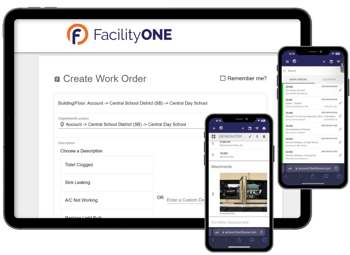 A modern, healthcare-ready computerized maintenance management system (CMMS) addresses the most common pain points hospitals face:
-
Real-time digital request portals for streamlined issue reporting
-
Automated preventive maintenance schedules based on asset type and location
-
Mobile tools that allow technicians to view, update, and close work orders on the go
-
Interactive mapping to see exactly where assets or issues are located
-
Reporting dashboards to measure performance, identify trends, and prepare for audits
These capabilities don’t just improve maintenance workflows—they support better care by ensuring a safer, more responsive hospital environment.
How FacilityONE Can Help
FacilityONE is trusted by hospitals and health systems across the country to modernize maintenance operations. Our F1 WORKS platform makes it easy to track, prioritize, and manage both corrective and preventive work orders—all in one intuitive interface.
With F1 MAPS, technicians and administrators can pinpoint asset locations, review work order history, and respond faster during emergencies. And with F1 INSIGHTS, you’ll gain visual reporting tools to optimize performance and prepare for compliance reviews with confidence.
Explore FacilityONE’s Healthcare Solutions
If your hospital is still relying on outdated systems, now is the time to change. See how FacilityONE’s modern CMMS can help you reduce risk, improve efficiency, and elevate patient care.